Architecture
Physical machines speak countless protocols, expose incompatible APIs, and resist the kind of uniform control that software expects. AI agents and autonomous systems need a single, reliable way to observe and act on hardware—without bespoke integrations for every device.
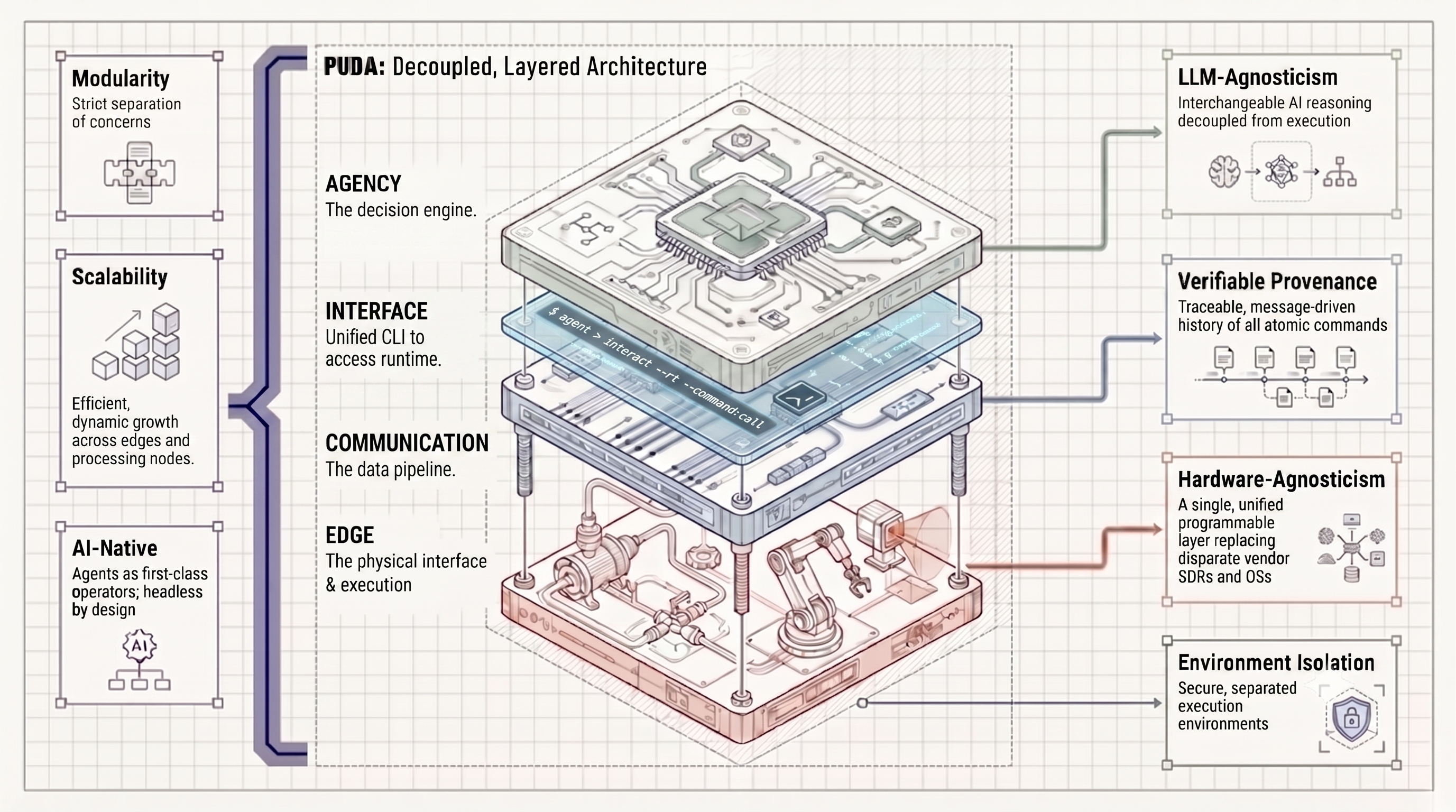
To solve this, we introduce the Physical Unified Device Architecture (PUDA): a hardware-agnostic, LLM-agnostic runtime environment designed to abstract complex hardware interfaces into a single, unified programmable layer. PUDA provides AI agents and software systems with a verifiable control plane over any physical machine, regardless of its underlying architecture.
Headless and message-driven
Headless by design and message-driven at its core, PUDA shifts the paradigm by treating autonomous agents, rather than humans, as first-class operators. By decoupling high-level AI logic from low-level physical execution, PUDA eliminates the friction of hardware fragmentation, enabling seamless, scalable deployment across diverse environments.
Design goals
The PUDA architecture is defined by core principles that transform how autonomous intelligence interacts with the physical world.
Modularity
By partitioning the stack into Agency, Interface, Communication, and Edge layers, PUDA ensures that the "brain" of the system is never hard-coded to the "nerves" and "muscles." This separation provides the foundation for hardware and LLM agnosticism, allowing you to swap components as technology evolves.
Scalability
PUDA is built to scale—supporting up to 1,000,000 devices and 300,000 commands per second. Integrating a new machine is designed to be straightforward and rapid, provided the device exposes a good programmatic interface.
AI-native
PUDA is built AI-first. By providing a fully observable environment where every command generates rich telemetry, we enable agents to operate with a high degree of situational awareness. This leads to verifiable provenance and environment isolation, ensuring that every action is logged, secure, and executed within a safe sandbox.